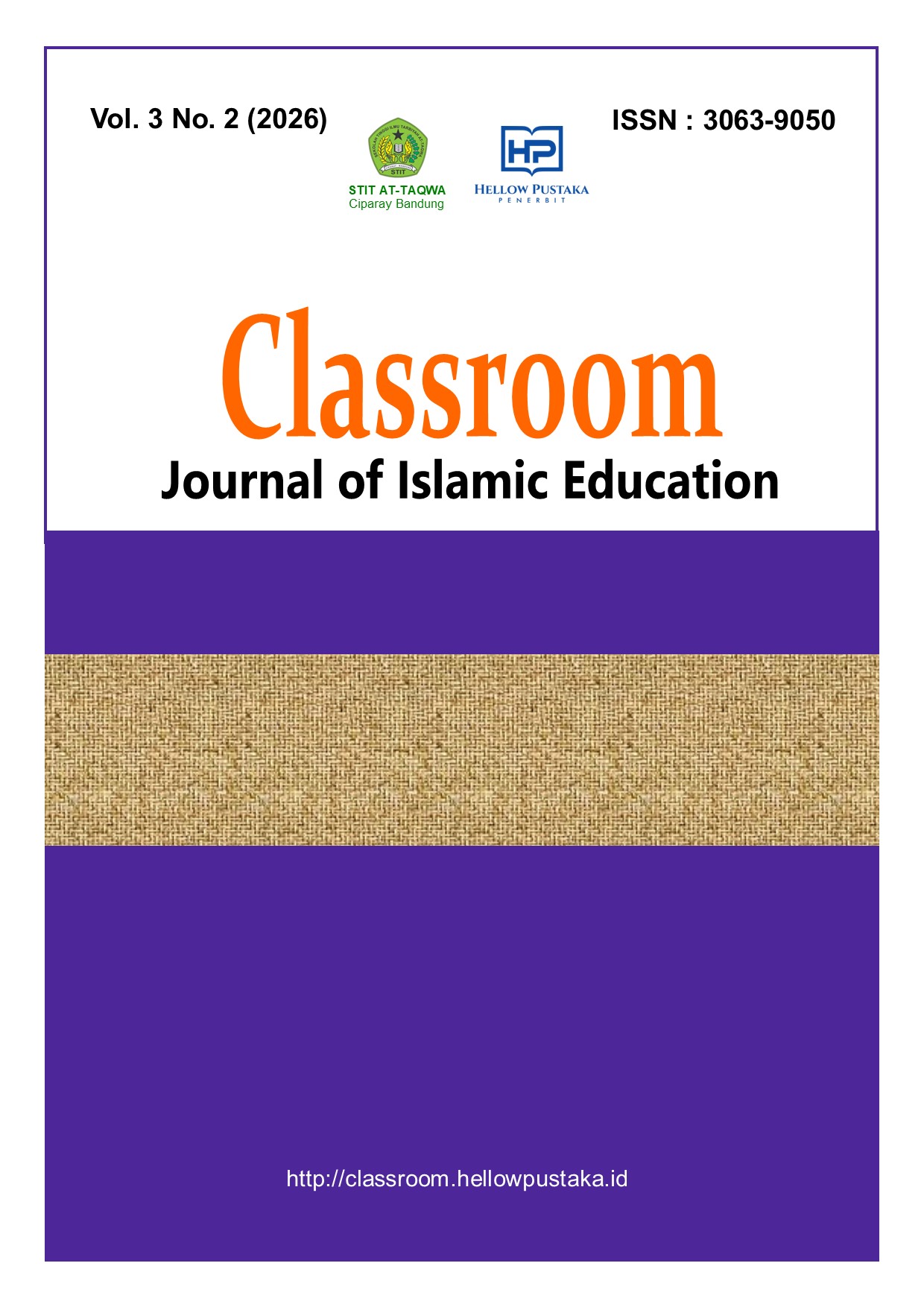
The Concept of Islamic Educational Philosophy from the Perspectives of Ibn Khaldun and Imam al-Ghazali
DOI:
https://doi.org/10.61166/classroom.v3i2.46Keywords:
Islamic Education Philosophy, Ibn Khaldun, Al-GhazaliAbstract
This article examines the philosophy of Islamic education from the perspectives of Ibn Khaldun and Al-Ghazali, focusing on educational goals, methods and strategies, and their relevance to contemporary Islamic education. The study employs a qualitative approach through library research, using primary sources such as Ibn Khaldun’s Al-Muqaddimah and Al-Ghazali’s Ihya’ ‘Ulum al-Din, as well as secondary sources including books and scholarly articles. Data were analyzed using content analysis and comparative analysis to identify key ideas, compare both thinkers, and construct an integrative conceptual framework. The findings show that Ibn Khaldun views education as a socio-historical process aimed at developing rational thinking, practical skills, and social readiness to build civilization. In contrast, Al-Ghazali emphasizes education as a means of purifying the soul and cultivating noble character to draw closer to God. In terms of method, Ibn Khaldun stresses gradual learning and empirical experience, while Al-Ghazali highlights moral exemplarity and spiritual guidance. The synthesis of these two perspectives results in a holistic model of Islamic education that integrates intellectual competence, social maturity, and spiritual depth to address the challenges of contemporary Islamic education.
References
Al-Gazzali, Abu Hamid. Ihya’’Ulum Al-Din. Dar al-Ma’rifa, 1982.
Al-Ghazali. Ayyuha Al-Walad. Beirut: Beirut: Dar al-Kutub al-‘Ilmiyyah, t.t., n.d.
———. Ihya’ ‘Ulum Al-Din, Juz 1. Beirut: Dar al-Fikr, t.t., n.d.
Handayani, Ega Putri, Muhammad Zalnur, and Fauza Masyudi. “Education and Social Dynamics from Ibn Khaldun’s Perspective: A Critical Review and Relevance for the Modern World.” DIROSAT: Journal of Education, Social Sciences & Humanities 3, no. 2 (2025): 242–53.
Hidayanti, Primasti Nur Yusrin, Miftahus Saâ, and Moh Buny Andaru Bahy. “Hakikat Pendidikan Menurut Ibnu Khaldun.” Islamadina: Jurnal Pemikiran Islam 23, no. 2 (2022): 207–22.
Jauhari, Muhammad Insan. “Konsep Pendidikan Ibnu Khaldun Dan Relevansinya Terhadap Pendidikan Di Era Modern.” Al-Manar: Jurnal Komunikasi Dan Pendidikan Islam 9, no. 1 (2020): 187–210.
Khaldun, Ibnu. “Mukaddimah, Terj: Masturi Ilham, Dkk.” Jakarta: Pustaka Al-Kautsar, 2011.
Khumaidah, Shirley. “Perbandingan Pemikiran Ibnu Khaldun Dan Al-Ghazali Tentang Pendidikan Islam Dan Relevansinya Terhadap Pendidikan DI Indonesia.” Mukaddimah: Jurnal Studi Islam 4, no. 2 (2019): 144–76.
Langgulung, Hasan. “Manusia Dan Pendidikan, Suatu Analisa Psikologi Dan Pendidikan,” 1986.
Muhaimin. Pengembangan Kurikulum Pendidikan Agama Islam. jakarta: RajaGrafindo Persada, 2012.
Nata, Abuddin, and Fauzan. Filsafat Pendidikan Islam. Gaya Media Pratama, 2005.
Nata, Abudin. “Filsafat Pendidikan Islam (Jakarta: Logos Wacana Ilmu, 1997) Cet.” I, n.d.
Ramayulis, Metodologi Pendidikan Agama Islam. “Ilmu Pendidikan Islam, Jakarta: Kalam Mulia, 2015, Cet.” Ke-Xii, n.d.
Saputra, Enggal Bagas Nova, Saiddaeni Saiddaeni, and Raha Bistara. “Ibnu Khaldun Dan Pendidikan Islam: Telaah Atas Al-Muqaddimah.” FiTUA: Jurnal Studi Islam 5, no. 1 (2024): 1–18.
Syahril, Sulthan. “RELEVANSI FRAGMEN PEMIKIRAN AL-GHAZALI, IBNU KHALDUN DAN IBNU SINA DALAM PENGEMBANGAN PENDIDIKAN ISLAM KONTEMPORER.” Ambarsa: Jurnal Pendidikan Islam 5, no. 2 (2025): 140–59.
Zahro, Umniiatuz. “Pendidikan Nilai Dalam Filsafat Pendidikan Islam: Pandangan Al-Ghazali Dan Ibnu Khaldun.” Tasyri: Jurnal Tarbiyah-Syariah-Islamiyah 31, no. 02 (2024): 122–38.
Downloads
Published
How to Cite
Issue
Section
License
Copyright (c) 2026 Mochamad Faidlul Abrori, Muhammad Arif Syihabuddin

This work is licensed under a Creative Commons Attribution 4.0 International License.